 RUN4IT
What's the Average Beer Mile Time? Benchmarks by Level
Key takeaways
- The average beer mile time for a social runner is roughly 8 to 12 minutes. First-timers often land at the slow end, because slow chugs and penalty laps add up.
- A standard beer mile is four 12-ounce beers at 5% ABV or higher, one before each 400-meter lap. A runner who vomits runs one penalty lap.
- Elite beer milers who pair sub-5-minute mile speed with fast chugging finish in under 6 minutes. The men's record is 4:28.10 and the women's is 5:43.81.
- Chugging usually explains more of the spread between times than running does. A 30-second chug instead of a 10-second chug adds 80 seconds across four beers.
- Compare your time to your own gender, division and experience level, and score your run splits separately from your drink splits.
The average beer mile time for a social runner is roughly 8 to 12 minutes, and men average slightly faster than women. One blended number hides a lot, though. Below are rough benchmarks by gender, division and experience level, so you can see whether your result is average, good or elite for runners like you.
What is the average beer mile time?
There is no official average beer mile time. No one publishes a dataset that splits results by experience level, so every benchmark in this guide is a rough guide built from typical crew-level races, not an official statistic.
The spread is wide because of the format. A beer mile is four laps, each preceded by a 12-ounce beer, and your time depends on your stomach as much as your legs. The blended number mixes elite chuggers running under 6 minutes with first-timers walking the last lap, so it says little about whether your own time is good.
Treat the blended average as trivia. The breakdowns by gender, division and experience below are the useful part.
How does a beer mile work?
The standard format is four beers and four laps of a 400-meter track. You drink one beer, run a lap, and repeat. The clock starts at the gun and stops when you cross the line after the fourth lap.
The beer. Each beer must be at least 12 ounces and at least 5% ABV, in a can or bottle. Light beers below 5% do not meet the standard rules.
The finish. Under the standard rules, no more than 4 ounces of liquid and foam may remain across all four beers. At sanctioned races, officials can disqualify a runner who leaves more.
The penalty lap. A runner who vomits before the finish runs one extra lap after the fourth lap. Vomiting more than once still means one penalty lap. If you want the full rule set, read our beer mile rules and race format guide.
What is the average beer mile time for men and women?
Men's times run faster than women's at the top end, because the elite men set a higher ceiling for both running and chugging. The records show the gap: the men's record is 4:28.10 and the women's is 5:43.81.
For social runners the gap narrows. Most club-level beer milers of either gender land somewhere around 8 to 13 minutes.
| Level | Typical men's time | Typical women's time |
|---|---|---|
| Record or elite | Under 5 minutes | Under 7 minutes |
| Competitive club runner | 6 to 8 minutes | 7 to 9 minutes |
| Social or brewery run | 8 to 12 minutes | 9 to 13 minutes |
| First-timer | 10 to 14 minutes | 10 to 14 minutes |
These rows are illustrative benchmarks, not official statistics. Compare yourself to your own division, not to the blended field.
How does division change the average?
Open division runners are the typical beer mile field: club runners, brewery run regulars and first-timers. A solid open time is usually 8 to 11 minutes, and slower finishes are common once the chugging catches up with people.
Elite beer milers are a different group. They are sub-5-minute milers who can also drink four beers without slowing down, which is why elite times fall under 6 minutes.
The elite profile is rare because it needs two skills most runners never train together: real mile speed and a stomach that handles four beers mid-race. Plenty of fast runners post beer miles of 7 minutes or more because the drinking, not the running, is the limit. If your open division time is under 10 minutes, you are ahead of much of the field.
What is a good beer mile time by experience level?
First-timers. Finishing under 10 minutes is a strong first beer mile. Many first-timers finish between 10 and 14 minutes, and that is fine. The first beer is where new racers lose the most time, so expect your first lap to feel slow and your legs to feel strange on lap two.
Experienced beer milers. Once you have raced a few, the targets tighten. A regular who has learned to pace the chugs and hold form on laps three and four can aim for 7 to 8 minutes. Seasoned racers sit around 6 to 7 minutes, and breaking 6 puts you in the conversation at any club race.
Read these numbers against your own crew, not against a blended average. Your first race tells you little about your ceiling. Track each attempt, note which beer cost you the most time, and race the same crew regularly.
How much does chugging skill change your time?
A beer mile is four 400-meter laps plus four beers, so the clock splits into run time and drink time. A decent social runner covers 1,600 meters in about 7 to 8 minutes, and an elite miler runs it in under 5. The running gap between crews is a couple of minutes, so the four drink stops are where most of the spread comes from.
The record times are only a little slower than a fast sober mile, and nobody gets there on legs alone. If a chug takes 30 seconds instead of 10, that adds 80 seconds across the race, which is more than most runners lose to pace.
Train the drink first. Practice finishing a beer quickly on non-run days, then practice drinking while out of breath. Run your laps at a pace you can hold after drinking, not at your fresh 400-meter pace.
How should you benchmark your own beer mile?
Fix your comparison group first, then check each split against it.
- Pick your bucket. Note your gender, division (open or elite) and honest experience level. A 9:30 open man and a 9:30 elite woman are not the same result.
- Score run and chug splits separately. If your laps are quick but the drinks are slow, chugging is your weakness, and the fix is different for each.
- Grade each piece. Call each split fast, average or slow for your bucket. Your overall time is only as good as your worst split.
Write the numbers down after every race. The trend across a season tells you more than any single result.
How do you train for a beer mile without wrecking your running?
Treat beer mile prep as three small add-ons to your normal run club week, not a separate plan.
- Pacing. Once a week, run one mile at your target race pace right after an easy run, so you learn what a mile feels like on tired legs.
- Chug practice. Once a week, practice drinking a carbonated drink quickly after hard effort. Use soda or non-alcoholic beer if you are not 21 or do not want the alcohol.
- Recovery. Treat the beer mile itself as a hard session, and follow it with two easy days.
Drink responsibly, never drive after a beer mile, and stop if you feel unwell. Beermile.com publishes the records, but no source splits averages by experience level, so treat any "beginner" or "elite" target here as illustrative.
How do you track beer miles and keep the streak going with your crew?
Most crews track beer miles with a group chat, a phone stopwatch and someone swearing they went faster last time. That works until the streak breaks because nobody wrote the time down.
Run4It tracks your run and shows the drink those miles earned, so the post-run beer becomes part of your streak. Every workout you log earns drinks and keeps your streak alive, and your crew can see who showed up.
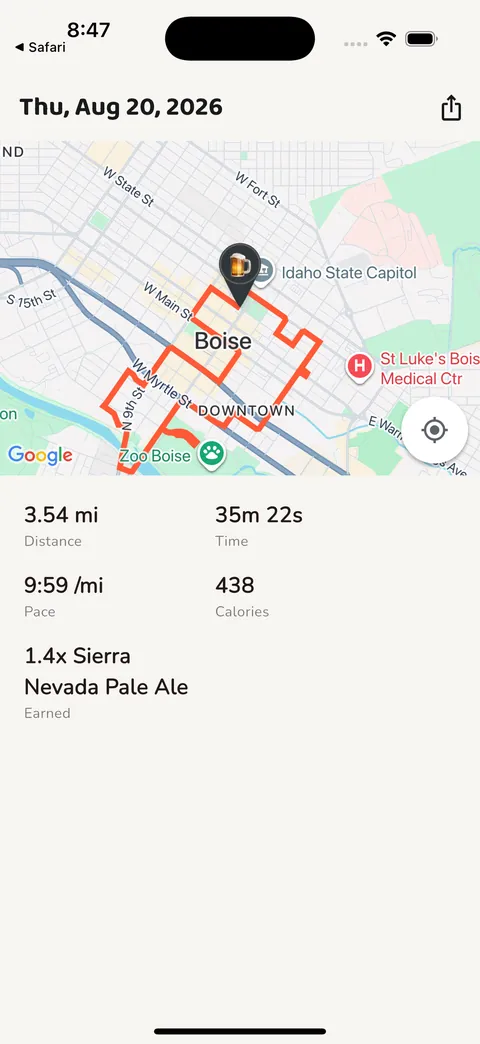
The earned drink is a motivational count, not a purchase, and the app does not sell or redeem drinks. Run4It does not time beer miles. It keeps the weekly habit around them.
FAQ
Is a 10-minute beer mile good?
Yes, for most runners. Ten minutes sits inside the open division range of 8 to 11 minutes and beats many first-time racers. If your run splits are quick and you still hit 10, chugging is your limit, not your legs.
How fast do you have to run a beer mile to qualify for worlds?
There is no single published cutoff that we could verify. Elite fields are drawn from the fastest recorded performances, which are under 6 minutes, so check current qualifying details with the event organizers instead of chasing a number from a chart.
Do you have to chug the whole beer in a beer mile?
Yes. Under the standard rules you finish each beer before starting the lap that follows it, and no more than 4 ounces may remain across all four beers. At sanctioned races, officials can disqualify a runner who leaves more.
What is the world record for the beer mile?
The men's record is 4:28.10 and the women's is 5:43.81. Check Beermile.com for the current list.
Can you do a beer mile with non-alcoholic beer or seltzer?
Not for a sanctioned record, which requires 5% ABV. Non-alcoholic beer and seltzer are fine for casual crew races or chug practice, but the result will not count as an official beer mile time.
FINISHED! BEER MILE STYLE. Run for it. You earned it.
Run4It is for adults 21 and over. Please drink responsibly and never drink and drive. Run4It is an independent app and is not affiliated with or endorsed by Beermile.com or any brewery mentioned.
Sources: Beer mile (Wikipedia), The Beer Mile: How to Race, Sip, and Survive Like a Pro (Marathon Handbook), GAF Beer Mile rules (RunSignup), Canadian breaks own world record, gets disqualified (CBC)